Nanoramic has launched eight new NXSP binder products to enhance lithium-ion batteries, focusing on increased energy density and improved manufacturing efficiency.
Nanoramic, recognized for its innovative battery material solutions, has unveiled an extensive catalog featuring eight new NXSP binders tailored for lithium-ion electrodes. This range includes four grades designed specifically for lithium-ion cathodes and an additional four grades for silicon anodes, positioning the company as a significant player in the rapidly evolving battery technology landscape.
Cathode Binders: Enhanced Energy Density and Cost-Effectiveness
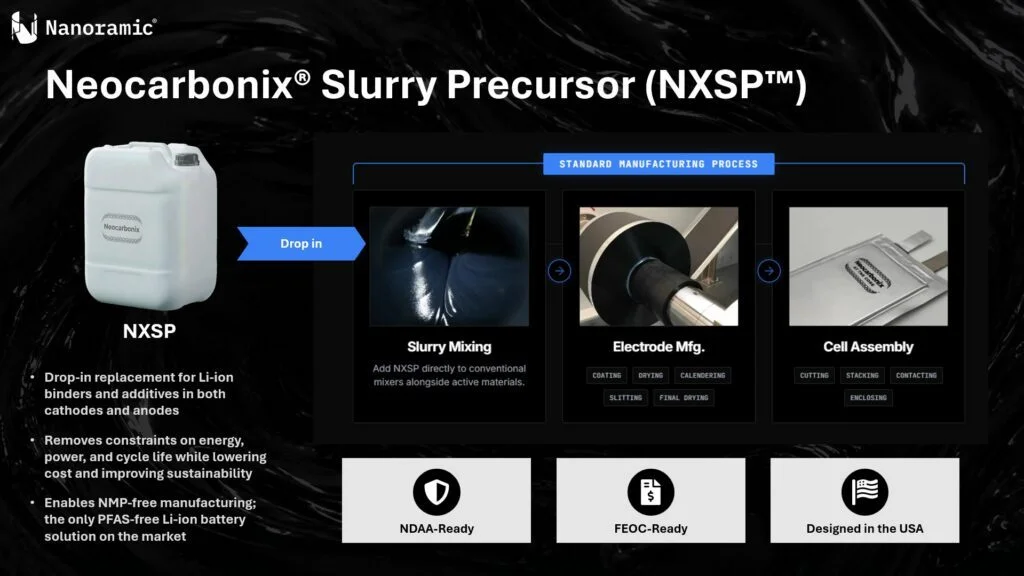
The NXSP product series for cathodes stands out due to its ultra-high solid content slurry. This characteristic is pivotal as it not only boosts energy density but also helps reduce manufacturing costs. The formulations are compatible with a variety of nickel-based cathode active materials (CAMs) and notably do not contain per- and polyfluoroalkyl substances (PFAS), which have come under scrutiny for environmental concerns.
- NXSP 310Y: Specifically designed for applications involving single-crystal nickel cobalt manganese (NCM), nickel cobalt aluminum (NCA), and nickel cobalt manganese aluminum (NCMA) active materials, this grade supports a diverse range of battery types.
- NXSP 330Y: This variant is optimized for high-loading NCM, NCA, and NCMA electrodes. It incorporates a dual-carbon network to enhance power performance, making it suitable for applications requiring quick energy release.
- NXSP 350Y: Targeted at polycrystalline NCM, NCA, and NCMA, this grade emphasizes high power output coupled with low cell resistance, essential for applications demanding sustained performance.
- NXSP 370Y: Focused on lithium iron phosphate (LFP), this binder supports higher mass loading while maintaining lower processing costs, making it an ideal choice for budget-conscious manufacturers.
Silicon Anode Binders: Addressing Volume Expansion Challenges
On the anode side, Nanoramic’s silicon binder series tackles the pervasive issue of swelling in silicon-carbon (Si-C) anodes. This series aims to strike a critical balance between enhancing energy density and managing the physical changes silicon undergoes during battery operation.
The silicon anode binders are categorized as follows:
- NXSP 620Z and NXSP 640Z: Designed for 20–50% Si-C compositions, these grades incorporate robust mechanical properties to accommodate Si-C expansion, with the 640Z utilizing a high-rate conductive network to reduce electrode resistance.
- NXSP 660Z and NXSP 680Z: Geared towards 50–100% Si-C formulations, these binders utilize low-resistance conductive architectures, with the 680Z specifically engineered to optimize electron transport for fast-charging capabilities.
Performance Benefits of NXSP Binders
The ultra-high solid content in the cathode slurry allows for quicker coating processes and reduced drying energy requirements, which are significant cost and time-saving factors in battery production. This aspect is especially crucial as manufacturers work to scale up production in response to growing global demand for lithium-ion batteries.
Additionally, Nanoramic’s designs aim to enhance electrode flexibility and mechanical integrity, factors that are essential for the reliability and performance of modern electric vehicle and energy storage applications. The company asserts that its silicon anode materials are crafted to maintain conductivity despite Si-C expansion and can withstand the inevitable volume variations that occur during battery cycling.
Industry Context and Future Outlook
John Cooley, the founder and CEO of Nanoramic, highlighted the importance of this product catalogue as a response to the increasing demands across various key applications within the battery industry. He noted, “The release of our standard product catalog was a necessary step to serve the broadening demand we are receiving across all key applications. This product standardization along with the mass production capacity we brought online earlier this year positions us for rapid, organic growth.”
This strategic move places Nanoramic in an advantageous position as electric mobility and energy storage technologies continue to expand. With the growing interest in high-performance lithium-ion batteries, the NXSP binders could play a critical role in helping manufacturers meet both performance standards and production efficiency.
For manufacturers seeking to enhance their battery technologies, understanding the capabilities and applications of Nanoramic's NXSP series is vital. As demand for electric vehicles and renewable energy solutions increases, materials that can efficiently improve battery performance will be key to staying competitive.


